
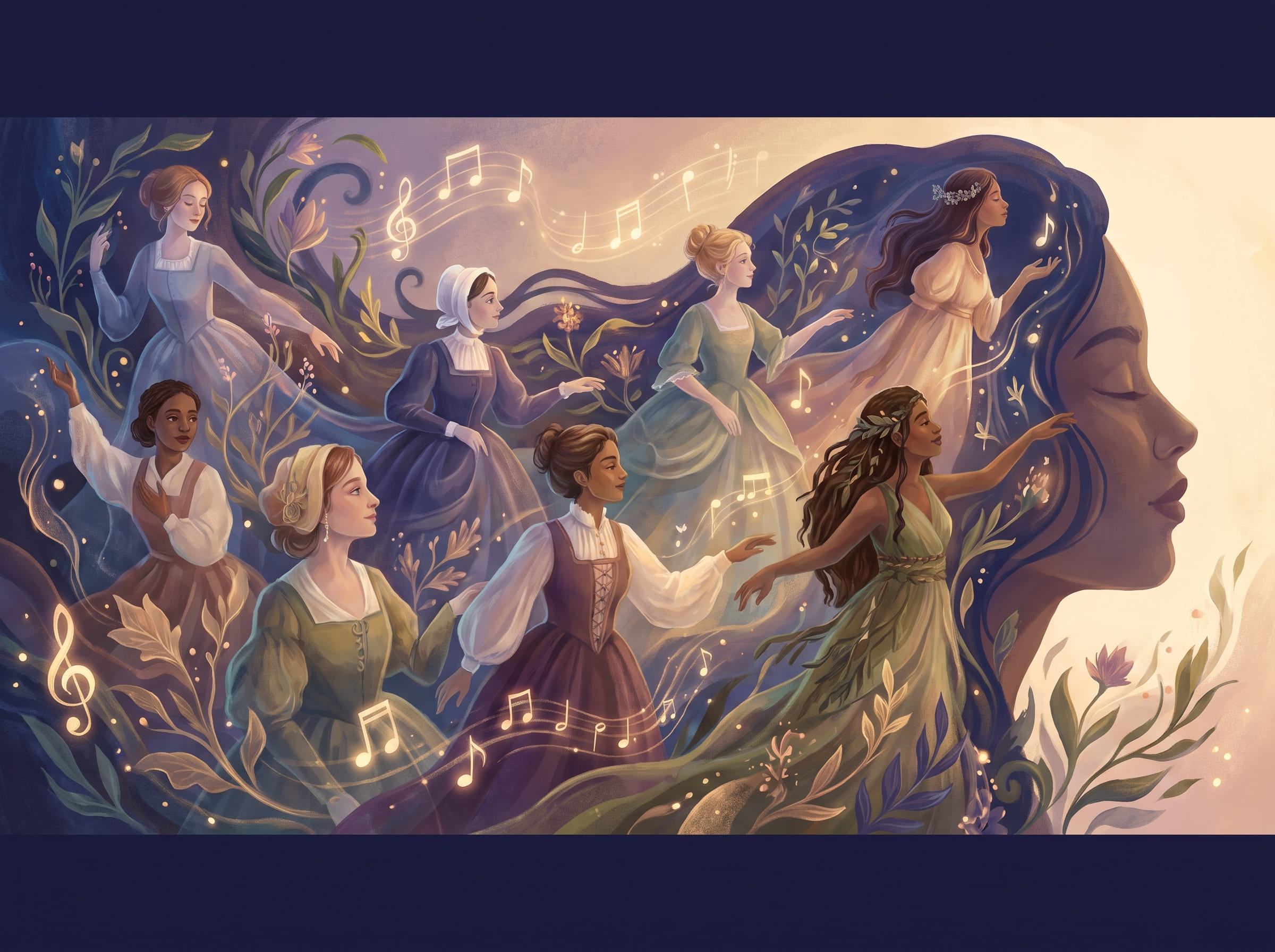
Inside every woman lives a wild chorus of selves waiting to be sung back to life
There is a reason why certain stories refuse to leave us. We encounter them at one stage of life, admire them, and move on. Then, years later, after heartbreak, motherhood, loss, love, reinvention, or healing, we return to them and discover that the story has changed. Of course, the story has not changed. We have.
One such story for me is the tale of La Loba, the Wolf Woman, told by Clarissa Pinkola Estés in Women Who Run With the Wolves. La Loba lives alone in the desert, collecting bones. She spends her days searching for what has been discarded, forgotten, abandoned, or left behind. When she gathers enough bones, she arranges them carefully and begins to sing. As her song rises, flesh grows over the skeleton, life returns, and the creature, often a wolf, comes alive. The wolf runs across the landscape and, in some versions of the story, transforms into a laughing woman who disappears over the horizon.
Each time I return to this story, I understand it differently. Today, I see it as a story about women and the lifelong journey of becoming ourselves.
A woman’s life is rarely lived by just one woman. Inside each of us live many women, each carrying her own memories, dreams, fears, and wisdom. There is the obedient girl who learned early how to please others and earn love through compliance. There is the daughter who absorbed the spoken and unspoken expectations of her family. There is the young woman who dreamed boldly before life taught her caution. There is the mother who placed her own needs on hold while nurturing others. There is the survivor who endured heartbreak, disappointment, loss, and uncertainty. And there is the creative, wild, intuitive woman who never stopped whispering beneath it all.
We carry them all. We also carry the women who came before us. Our mothers, grandmothers, and countless ancestors live within us in ways we often fail to recognise. Their stories are woven into our beliefs, our habits, our fears, and our strengths. We inherit more than genetics. We inherit ways of loving, ways of coping, ways of surviving. We inherit resilience, compassion, determination, and wisdom. Yet we also inherit silences, limitations, and fears that belonged to another time.
Many of our mothers and grandmothers learned that survival required sacrifice. They learned to endure, adjust, and carry burdens quietly. They often swallowed their anger, postponed their dreams, and silenced parts of themselves in order to keep families and communities functioning. Their choices were not signs of weakness but reflections of the realities they lived within. Their courage paved the way for many of the freedoms women experience today.
Yet honouring those women does not mean repeating their struggles.
There comes a point in every woman’s journey when she must decide what she wishes to carry forward and what she is ready to set down. Positive feminism, to me, is not about rejecting the past. It is about honouring it while choosing consciously what belongs in our future. It is about recognizing that the women before us gave us extraordinary gifts, but also understanding that some inheritances are meant to be transformed rather than preserved.
This transformation begins when we stop trying to become who we think we should be and start remembering who we already are. So many women spend years pursuing self-improvement while secretly longing for self-discovery. They believe they need more confidence, more discipline, more qualifications, or more validation. Yet beneath these pursuits often lies a deeper yearning. They are searching for the pieces of themselves they left behind along the way.
The artist who stopped creating or The dreamer who stopped imagining or The adventurer who stopped exploring or The playful girl who stopped laughing or The woman who stopped trusting her own voice.
Like La Loba searching the desert for bones, we begin gathering these forgotten pieces. We revisit old passions. We question inherited beliefs. We challenge roles that no longer fit. We listen more carefully to the quiet voice within us. Gradually, we discover that authenticity is not about becoming someone new. It is about recovering what was always ours.
As an expressive arts therapist, I witness this process often. Women arrive believing they need fixing. What unfolds instead is remembrance. Through creativity, storytelling, movement, and reflection, they reconnect with aspects of themselves that have been waiting patiently beneath years of responsibility and expectation. Healing is rarely about adding something new. More often, it is about removing what no longer belongs and creating space for the authentic self to emerge.
The authentic self is not one version of a woman. It is the integration of many versions. It is the ability to welcome the daughter, the mother, the creator, the warrior, the nurturer, and the wild woman into the same room without forcing any of them to disappear. It is understanding that strength and softness can coexist. That ambition and tenderness can coexist. That vulnerability and power can coexist.
Perhaps this is why the image of the running woman at the end of La Loba’s story feels so powerful.
She is not running away from herself… She is running toward herself.
She carries generations within her, yet she is not bound by them. She honours the wisdom of those who came before while allowing herself to imagine a different future. She no longer seeks permission to exist fully. She no longer apologizes for taking up space. She understands that her value is not measured by how much she sacrifices but by how authentically she lives.
And she laughs.
I find that detail deeply moving. For centuries, women have been celebrated for their resilience, their caregiving, and their ability to endure. These qualities are admirable. But joy is equally important. Creativity is important. Playfulness is important. A woman who laughs freely, who celebrates herself without guilt, who delights in her own existence, is participating in a profound act of liberation.
Perhaps that is the true gift of La Loba’s story. It reminds us that every woman carries wisdom in her bones. It reminds us that even the forgotten parts of ourselves can be revived. It reminds us that the journey of becoming is not about abandoning who we have been but embracing every version of ourselves with compassion.
And when we finally gather all those pieces, when we stop hiding, shrinking, and apologizing, something extraordinary happens.
We rise. We run. We laugh.
And for the first time, we meet ourselves in the open field of our own freedom.
Author bio: Surbhi Sethia, is CEO – Roots the Foundation, UN Speaker and has over 20 years experience in mental health practice. Reach out to her on 7200824512 for all your counselling needs.